For White Folks Who Teach in the Hood... and the Rest of Y'all Too by Christopher Emdin
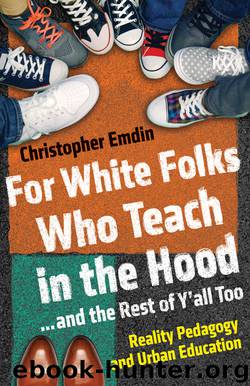
Author:Christopher Emdin [ Emdin, Christopher]
Language: eng
Format: epub
ISBN: 978-0-8070-0641-2
Publisher: Beacon Press
Published: 2016-01-01T05:00:00+00:00
Cosmopolitanism and the Neoindigenous
For white folks who teach in the hood, and any teacher who feels unsettled by the misalignments between the culture of youth and their own ways of knowing and being, the way forward is to view tension in the classroom as an asset for creating a truly cosmopolitan space. Sociologist Ann Swidler argues that it is in these unsettling moments that people can co-create practices and philosophies that establish a powerful new culture. I argue that it is in the acceptance of their vulnerability in these moments that teachers begin to move from place to the emotion-laden spaces that the students inhabit. In other words, the teachers’ acceptance of their vulnerability connects them to students who are often vulnerable because of how they are positioned in society. It is this joint vulnerability that is the prerequisite for change.
The typical response that a teacher (or anyone for that matter) has to feeling scared or vulnerable is to try to exert power over students (or anyone perceived as “other”). This is why teachers of urban youth of color become strict disciplinarians, and why students often alienate peers whom they view as different. To counter this phenomenon, humans have to be reconnected to each other through new and shared cosmopolitan practices.
This crafting of new and shared practices in the classroom social world requires an understanding of the racial, socioeconomic, dominant language groupings that exist in the classroom. Furthermore, it requires an understanding of the privileges that certain individuals have because of the groups of which they are a part. The point is not to force everyone to be a part of the dominant culture, but rather to move everyone to be themselves together. The current education system rewards both students and teachers who blindly assimilate into an anticosmopolitan and anti-neoindigenous school structure. The celebration of a homogenous student identity and denigration of expressions of neoindigeneity force many among the neoindigenous to assimilate into a set of school norms, which requires them to repress their authentic selves. For example, in a middle school classroom I worked in, a student was repeatedly celebrated for “sitting quietly on your own” while another was consistently scolded for “speaking too loudly with your friends.” In one instance, the student who was praised smiled and sat at his desk with his hands clasped together while the one who was scolded responded to the teacher by saying, “But I was just trying to help them solve the math problem. They needed help so I was trying to help them.” The teacher ignored the student’s defense of his action, and then began to praise the student who sat quietly alone.
In many ways, teachers are hardwired to look favorably upon students who remind them of themselves. Scientists have identified mirror neurons that fire in us when others act in ways that we find familiar. In other words, the teacher wants to see herself in her students even if that runs counter to who her students are. Unfortunately, over time,
Download
This site does not store any files on its server. We only index and link to content provided by other sites. Please contact the content providers to delete copyright contents if any and email us, we'll remove relevant links or contents immediately.
The Art of Coaching Workbook by Elena Aguilar(51152)
Trainspotting by Irvine Welsh(21635)
Twilight of the Idols With the Antichrist and Ecce Homo by Friedrich Nietzsche(18618)
Fangirl by Rainbow Rowell(9228)
Periodization Training for Sports by Tudor Bompa(8250)
Change Your Questions, Change Your Life by Marilee Adams(7753)
This Is How You Lose Her by Junot Diaz(6873)
Asking the Right Questions: A Guide to Critical Thinking by M. Neil Browne & Stuart M. Keeley(5752)
Grit by Angela Duckworth(5598)
Red Sparrow by Jason Matthews(5463)
Paper Towns by Green John(5175)
Room 212 by Kate Stewart(5102)
Ken Follett - World without end by Ken Follett(4719)
Housekeeping by Marilynne Robinson(4434)
The Sports Rules Book by Human Kinetics(4377)
Double Down (Diary of a Wimpy Kid Book 11) by Jeff Kinney(4257)
Papillon (English) by Henri Charrière(4255)
The Motorcycle Diaries by Ernesto Che Guevara(4087)
Exercise Technique Manual for Resistance Training by National Strength & Conditioning Association(4057)
